Modern Farmhouse Fireplace Ideas: Mantel, Surround, and Scale

The first time I got seriously into fireplace research, I was sitting in a typical apartment in January, wrapped in a throw blanket that was doing its best work, wondering why the space felt nice but not actually warm. Not temperature-wise, just warm in the way a room either is or isn’t. That’s when I realized what was missing.
A fireplace does something no amount of throw pillows can replicate. Modern farmhouse style, specifically, has found a way to make fireplaces feel approachable: not formal, not museum-like, just genuinely livable. These 20 modern farmhouse fireplace ideas cover a range of materials, formats, and budgets, from the classic white brick to some designs that are surprisingly out of the ordinary.
The Classic Farmhouse Fireplace
White Brick With a Wood Mantel
The white brick fireplace is the foundation of modern farmhouse style for a reason. It gives you contrast without drama, texture without mess. What makes this work consistently is the proportions: the mantel needs to be thick and solid-looking, not just decorative trim. I’d keep the mantel styling simple: a single piece of pottery, maybe a short stack of books, and resist the urge to overcrowd it. The fireplace itself is doing the work. If you load the mantel, you cancel it out.

Built-In Fireplace With an Oversized Mirror
Built-in fireplaces feel permanent in a way that freestanding units don’t, and that permanence projects confidence in a room. The trick here is the mirror: I’ve seen this done badly (tiny mirror over a big fireplace) and done right. When the mirror matches the fireplace width, it doubles the visual height of the whole wall without adding any visual clutter. If you’re renting and this isn’t an option, a frameless or light-framed leaning mirror achieves a similar effect for a fraction of the cost. The proportional relationship between mirror and fireplace is what actually matters, not the price tag.

Clean Neutral Lines
Some fireplaces just get out of their own way. This one, with its simple white-gray palette and clean surround, is exactly the kind of backdrop that lets the rest of a room work harder. I’d use it as an anchor point for warmer textures: a linen sofa, jute rug, one wood element in the coffee table. The fireplace doesn’t need to be the showstopper when it frames the whole room this well. This is the design I’d choose for a space where I wanted a fireplace presence without committing to a style statement.

Concrete Surround and Built-In Bookshelves
Ranch style and modern farmhouse overlap more than people realize. They share a love of natural materials and unpretentious form. This concrete surround paired with built-in shelves is a version of that crossover that genuinely works. The concrete keeps it contemporary while the shelves add the kind of lived-in quality that makes a fireplace wall feel like a real part of the home, not just a design feature. For more context on the broader ranch aesthetic and how it relates to this kind of material palette, ranch style interior design goes into the details.

Stone, Brick, and Raw Materials
When farmhouse design leans into raw materials, the fireplace is where it’s most convincing. Stone isn’t just texture. It carries weight, and a stone fireplace gives a room a kind of solidity that painted drywall never will. The question is always how much stone, and in what form. The answers below cover a range from understated to fully committed.
Rough Stone With a Clean White Firebox
The contrast between rough-cut stone and a clean, unadorned firebox is one of the more reliable combinations in modern farmhouse design. It’s not trying to be a mountain lodge. It’s edited down to the key elements. A clean white firebox against rough texture says more about design confidence than a heavily styled mantel ever could. The stone does the interesting work; the firebox just needs to stay quiet.

Full Rustic Stone Surround
This is the version where the stone does all the talking. No mantel details, no accents, just a generous stone surround with a straightforward firebox at the center. I’ve seen this in farmhouse builds trying to evoke Southern France and in new construction trying for a heritage feel. Both work because stone doesn’t date itself the way finishes do. What I’d watch for: the room needs breathing room around it: soft furnishings, not more stone.

Floor-to-Ceiling Stone Chimney
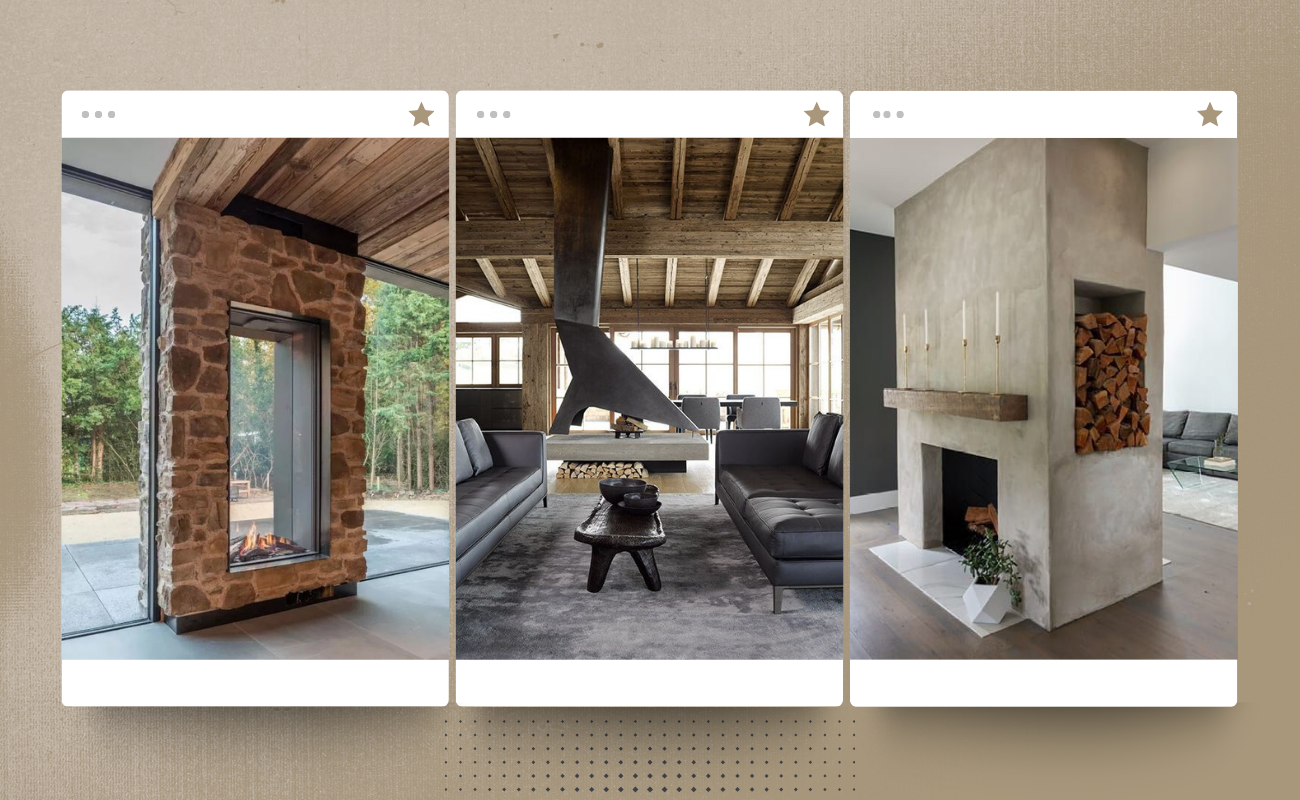
A fireplace that goes all the way to the ceiling changes the scale of a room. In a space with exposed beams, this is almost too good, and the vertical stone breaks up the horizontal wood in a way that feels compositionally balanced. The main thing I’d watch for: the room needs enough floor space to appreciate it from a distance. In a smaller room, this particular design starts to feel heavy. It needs volume around it to breathe.

Stone Fireplace Paired With a Large Window
This combination doesn’t get enough attention: a stone fireplace positioned next to a large window so you see natural material inside and outside in the same sightline. The window keeps the stone from feeling closed-in. It’s the difference between cozy and heavy. I find this particularly good in rooms where you want warmth without sacrificing the connection to natural light. If this is the direction you’re taking a space, the farmhouse cottage decor guide covers some of the same material instincts in a softer palette.

Minimal Lines, Maximum Warmth
Minimal and farmhouse are not opposites, despite what most farmhouse inspiration content implies. The original farmhouse aesthetic was functional first. Decoration came second, if at all. The modern version has kept that sensibility, and the fireplaces below are evidence of it. When you strip a farmhouse fireplace down to its essentials, what you get is often more interesting than anything heavily styled.
White Marble Surround
Marble in a farmhouse context surprises people, but it makes more sense than it first looks. White Carrara marble with soft gray veining feels natural rather than formal. It’s a stone that happens to be polished, not a material that’s trying to impress. I’d use this in a kitchen or a more polished room where you want farmhouse warmth without the woodsy heaviness. The honest budget version: marble-look contact paper on an existing surround works better than it has any right to, especially from a distance.

The Floating Minimal Fireplace
A completely minimal surround: just a clean rectangular opening with a flat panel above, depends entirely on what surrounds it. The room has to bring the warmth. I’ve applied this principle in my current apartment layout (no actual fireplace, just a console styled to mimic the same visual proportions) and the logic holds: when the surround is stripped down, furniture placement and soft textures matter more than anything else. This is the fireplace for people who genuinely prefer rooms to do the work.

Freestanding Stone Fireplace
The freestanding stone fireplace works in rooms that can afford to lose floor space around it. What I find underrated here is that the stone wraps all the way around, so you’re not committed to a wall placement, which means the room arrangement stays flexible. That’s actually useful for renters thinking about how to direct visual attention without permanent changes. It’s a piece of furniture as much as it’s a fireplace, and in a high-ceiling room it’s the right choice for that reason.

Going Dark: Black Accents and Bold Contrast
Most modern farmhouse fireplace inspiration stays firmly in the neutral zone. I think that undersells what dark elements can do in this context, specifically, how a dark frame or surround makes a live fire look warmer by contrast. The designs below use black and dark tones intentionally, not as a dramatic statement but as a way to ground the warmth of the fire.
Black Woodwork Against Natural Floors
The black woodwork framing this fireplace turns what could have been a standard white-brick hearth into something with more personality. What keeps it farmhouse rather than gothic is the warm wood floor and the linen sofa, and the dark frame needs warm neutrals around it to stay grounded. Without that context, it tips into drama. With it, the contrast feels deliberate and comfortable. This is one of those combinations that photographs better in person than it sounds on paper.

Industrial Hood Over a Farmhouse Hearth
An industrial hood might seem like the wrong call for farmhouse style, but the logic is sounder than it looks. Farmhouses historically had functional kitchen equipment. The hood is a descendant of that working-kitchen tradition. When paired with wood ceiling beams and the built-in log storage below the firebox, this reads as the kind of kitchen-hearth hybrid that makes sense in open-plan spaces. It’s the design I’d choose for a space that needs to feel genuinely lived-in rather than styled for a photoshoot.

Exposed Brick and a Black Metal Stove
This is the most honest version of the farmhouse aesthetic on this entire list. Exposed brick, a wood-burning metal stove, a concrete base for the log pile. Nothing here is trying to impress anyone. I find it the most livable of all these designs because it looks exactly as functional as it is. The practical note: a cast-iron wood stove insert is significantly less expensive than a built-in firebox, and good used models from brands like Jotul or Morso can be found for under $600. You’re not sacrificing performance for the price difference, either.

Designs That Break the Mold
Not every modern farmhouse fireplace has to be a white rectangle on a wall. Some of the most interesting versions of this aesthetic come from departing from the standard format entirely. These six designs are for the spaces (and the people) who want something a little harder to find on a mood board.
Two-Sided Fireplace Between Rooms
A two-sided fireplace is an obvious functional choice when you have a divider wall between two rooms that both need heat, but the design angle is what I find underused: it creates two different fireplace compositions from two different perspectives. The same firebox looks different depending on which room you’re viewing it from, and that’s actually an interesting creative constraint. It’s also the most efficient use of a single firebox I can think of.

Round Fireplace Design
Round fireplaces are deliberately different in a room full of rectangular furniture, and that visual pause is exactly the point. The key to making this work in a farmhouse context is material: keep the surround in natural stone or a whitewashed finish, and the round shape feels organic rather than out of place. In a room that’s already doing interesting things with texture, this is the kind of focal point that earns its position without competing with everything else.

Indoor-Outdoor Pass-Through Fireplace
The pass-through fireplace that serves both an interior and an outdoor entertaining area is a practical luxury for anyone who uses their outdoor space in cooler months. The same heat source covers both sides, which is smarter than it sounds, especially in places like a rental city where January evenings still happen and still get cold enough to matter. If this kind of indoor-outdoor connection is a priority for the whole room, the coastal farmhouse decor approach covers how to carry that connected feeling through the rest of the space.

The Gyrofocus Hanging Fireplace
The Gyrofocus is technically a design object that happens to function as a fireplace. The suspended model by Focus Fires has been around since the 1960s and still looks like nothing else on the market. Whether it belongs in a modern farmhouse depends on how loosely you interpret the aesthetic. In a high-ceiling farmhouse with exposed structure and a minimal material palette, it works. In a more traditional farmhouse setting with lots of wood and texture, it might look like a visitor from another decade. Which, to be fair, it is. Worth knowing before you consider it seriously.

Sculptural Steel Chimney as Room Focal Point
When the chimney itself becomes the design element, everything else in the room needs to step back. This sculptural version in raw steel is a statement in the best sense: it doesn’t apologize for what it is. The warm wood ceiling behind it provides just enough contrast to keep the space feeling livable rather than cold. If you use this, keep the furniture simple and low, and let the fireplace carry the vertical energy of the room rather than competing with other tall elements.

The Tabletop Bioethanol Fireplace
The small bioethanol tabletop fireplace is the most renter-friendly option on this list by a wide margin. It produces a real flame, needs no installation, and costs between $60 and $150 for a reliable model. I’ve used the Ignis brand on a small tabletop version and found it straightforward: easy to fill, predictable burn time, no mess. The honest caveat: heat output is minimal, so it functions as ambiance more than heating. For a small apartment or a corner that just needs some visual warmth, that trade-off is completely reasonable.

Frequently Asked Questions
What defines a modern farmhouse fireplace?
A modern farmhouse fireplace combines natural materials like stone, brick, or wood with clean, simplified forms. The defining quality is restraint: the materials are rustic but the design itself is uncluttered. Think thick wood mantels, white brick surrounds, raw stone, or simple blackened steel, but without ornate trim or heavy Victorian detailing.
What materials work best for a farmhouse-style fireplace surround?
White brick, rough-cut stone, raw concrete, and natural wood are the most consistent choices. White brick is the most versatile and pairs well with almost any furniture. Stone works best in larger rooms that can handle the visual weight. Concrete skews more contemporary within the farmhouse style, which suits rooms with mixed influences.
Can I add farmhouse fireplace style to a rental?
Yes, and more easily than most people expect. A leaning oversized mirror above an existing fireplace changes the proportions dramatically. Bioethanol tabletop fireplaces require no installation and produce a real flame. Marble-look contact paper on an existing surround improves its appearance for very little money. None of these require permanent changes.
How do I style a modern farmhouse fireplace mantel?
Keep it spare. One large object is better than many small ones. Good options: a single piece of ceramic, a short stack of books with a candle, a small framed print. Resist the urge to fill the mantel. The fireplace below it is the focal point, and a crowded mantel competes with it rather than complementing it.
What’s the most affordable way to update an existing fireplace to a farmhouse look?
White paint on an existing brick surround is the highest-impact, lowest-cost change you can make: a few dollars in limewash or matte white paint transforms a dated orange-brick fireplace. After that, replacing an ornate mantel with a simple thick wood beam costs under $200 for basic lumber. Both changes together take a weekend and make a significant difference.