Boat Interior Design: Every Surface Has a Job

Boat interior design operates under a different set of rules than residential work. The constraints are real: limited square footage, constant moisture exposure, weight restrictions that affect every material decision, and the need for everything to stay in place when the boat is underway. I’ve consulted on a few boat interior projects over the years, and the first thing I tell clients is to set aside most of what they learned from home renovation. The priorities reset almost entirely when you’re working below decks.
What makes it genuinely interesting is that those constraints force clarity. You can’t default to “add a bookshelf” or “throw a rug down.” Every choice has to work harder than it would in a house. The materials, the layout, the lighting system: each one needs to function as part of a tightly integrated whole. That challenge is what draws serious designers to marine work, and it’s why a well-executed boat interior is more impressive than it might look at first glance.
Key Takeaways
- Boat interiors demand materials that withstand salt air, moisture, and UV exposure. The wrong choice fails fast and expensively
- Every square foot has to earn its keep: the best boat layouts combine storage, seating, and function in the same footprint
- Lighting design on a boat is about energy management as much as aesthetics, and doing both well is entirely possible with the right approach
Fundamentals of Boat Interior Design
The principle that runs through every successful boat interior is this: every element serves at least two purposes. A settee isn’t just seating: it’s storage and spatial definition. A counter isn’t just a work surface: it’s a visual anchor that sets the color tone for the whole cabin. When I look at a boat interior that feels cohesive and resolved, it’s almost always because the designer understood that rule and built around it consistently.
Minimalism in boat interiors isn’t a style choice so much as a structural necessity. Clutter becomes a safety issue when the vessel is moving. Things fly. Things get wet. Objects that aren’t secured become projectiles. The clean lines and uncluttered surfaces you see in well-designed boat cabins aren’t an aesthetic preference; they’re the result of understanding the environment. That said, minimalism doesn’t mean cold or sparse. The right materials and proportions can make a compact cabin feel considered and warm without adding unnecessary objects to the space.
Looking at a 42-foot sailing catamaran project a few years ago where the brief was essentially: it needs to feel like home, but it also needs to survive a gale without losing half the contents of every locker. The solution was marine-grade upholstery in a warm sand tone, built-in lee cloths that doubled as textile accents, and storage that integrated into every available vertical surface. The result didn’t look like a boat catalog. It looked like a well-designed small apartment that happened to float. That project changed how I think about what “comfort” means in a constrained environment.
For anyone working through their first boat interior project (or planning a refit of an existing vessel), the sections below cover the decisions that actually move the needle. The goal is a space that functions well under pressure and still feels like somewhere you’d want to spend a week. Those two things aren’t in conflict, but getting there requires making the right calls in the right order. My guide on harmony in interior design covers how these same integration principles apply in residential contexts, if that reference point is useful.
Material Selection
The most common mistake I see in boat interior projects is applying residential material logic to a marine environment. Materials that perform beautifully in a house can fail completely on water. Salt air is corrosive. Humidity cycles are extreme. UV exposure through portholes and hatches degrades finishes that would last decades on land. Selecting the right materials isn’t a secondary consideration, it’s the foundation the entire design sits on. Get this wrong and nothing else matters.
Wood and Veneer

Teak remains the standard reference point for marine joinery because it works. The natural oil content resists moisture, it stays convincing under repeated cleaning with harsh products, and it ages into a silver-grey that actually looks good on a vessel. Mahogany and cherry are also strong performers in protected interior spaces, though they require more maintenance in high-humidity environments. Solid hardwood is heavier than alternatives, which matters on a performance sailboat, but in a powerboat or cruising catamaran the weight is often worth trading for the visual quality.
Veneer over marine plywood is the practical middle ground in most projects. It brings the warmth and visual quality of real wood at lower weight and cost, and when the substrate is properly sealed and the veneer well finished, it’s a reliable choice for cabinets, berth surrounds, and companionway trim. The critical detail is edge treatment: any exposed end grain is a moisture entry point. I’ve seen genuinely beautiful veneer work fail within two seasons because the edges weren’t sealed. Get the substrate right, protect every edge, and veneers will last the life of the vessel.
Fabrics and Upholstery

Marine-grade textiles have improved significantly over the past decade. Solution-dyed acrylic fabrics now come in a wide enough range of colors and textures that you’re no longer forced to default to navy and white just because those were historically the durable options. I’ve specified warm oatmeal tones, muted terracottas, and deep forest greens in recent projects, all in fabrics that hold up to sun, salt, and soaking without fading or degrading. The critical specification is solution-dyed acrylic: the color goes all the way through the fiber, not just the surface treatment, which is why it resists UV damage far better than printed alternatives.
Cushion foam is a decision that affects not just comfort but the longevity of the upholstery itself. Closed-cell foam resists moisture absorption, which is important in spaces that may get wet from spray or a leaking hatch. Reticulated foam allows airflow and helps with drying after exposure. A combination layer, reticulated core with a closed-cell surface, often performs best. What I’d strongly avoid is standard residential foam: it absorbs water, takes days to dry fully, and becomes a mold problem in short order. In a house this question never comes up. On a boat it’s one of the most consequential specification calls you’ll make.
Flooring and Carpets

Flooring choices involve trade-offs between weight, traction, maintenance, and visual warmth. Solid wood looks exceptional but adds weight to the vessel and requires careful sealing on every edge to prevent moisture ingress. I’ve seen beautiful solid teak soles fail within three years because the installation didn’t account for the seasonal expansion caused by humidity cycling on the water. If you’re committed to real wood, engineer-grade over marine plywood is more dimensionally stable and performs better across humidity changes.
Engineered hardwood is generally the better call for most liveaboard and long-range cruising applications. A real hardwood face bonded to a stable plywood core gives you the visual quality of solid wood without the movement issues. The veneer layer is thick enough to sand and refinish once or twice over the vessel’s life, which matters for long-term ownership. The weight savings over solid wood are real, and the installation is more forgiving in the curved spaces that boat soles tend to require.
Luxury vinyl plank has become a credible option in boat interiors over the past several years. It’s lightweight, genuinely waterproof, and available in wood and stone appearances that read well in a properly lit cabin. The main limitation is heat: vinyl can soften or expand in boats left in the sun with hatches closed in summer. In a temperate climate or a well-ventilated vessel it performs reliably. I’ve specified it on several budget-focused interior refreshes and it’s held up well across two and three seasons.
Marine carpet is worth considering for forward cabins and sleeping berths where barefoot warmth matters and the space doesn’t see much water traffic. Polypropylene is the fiber of choice, it resists moisture, dries quickly, and doesn’t support mold growth the way natural fibers do. Avoid any carpet with a jute or felt backing: it holds moisture and deteriorates fast. A marine-rated synthetic backing bonded properly to the sole prevents that problem entirely. The same principle of layering hard and soft flooring for both performance and visual warmth comes up in compact residential design projects as well.
Lighting and Atmosphere
Lighting on a boat serves three distinct functions: task lighting for navigation and galley work, ambient lighting for habitability and general atmosphere, and safety lighting for moving around underway at night. A well-designed lighting system addresses all three without treating them as separate problems. The power budget is finite and matters more here than in any residential project, which is why LED technology has become the baseline standard rather than an upgrade.
LED Lighting

The practical advantages of LED for marine applications are significant enough that there’s no real argument for anything else. Lower draw, longer lifespan, and far less heat generation than incandescent alternatives make LEDs the right call in every zone. The design opportunity is in the color temperature choices: warm white (2700-3000K) in the saloon and staterooms for a residential feel, neutral white (4000K) in the galley where accurate color rendering matters for food preparation, and dim red or blue for cockpit use at night to preserve night vision. Dimmer control adds another layer of flexibility. Installing recessed strip lighting under cabinetry runs in a couple of projects that looks ambient light during the day and task lighting at night, one installation, two functions, which is exactly the kind of thinking that works in constrained spaces.
Natural Light

The availability and direction of natural light through portholes, hatches, and deck prisms is one of the first things I assess on any boat interior project. It’s not adjustable after the fact without structural work, so understanding what you have before making color palette and material decisions is essential. A forward cabin with two small portholes on each side reads very differently at anchor on a bright afternoon than it does on a grey passage morning. Design for the light you actually have, not the light in the reference photos.
Mirrors and light-colored surfaces can stretch the apparent brightness of a cabin that doesn’t receive direct light. I’ve used full-panel mirrors in narrow quarterberths to make them feel twice as wide, and I’ve specified white or very pale neutral overheads throughout dim cabins to reflect what natural light exists further into the space. The fabrics and materials need to support that logic too: dark upholstery absorbs what little light arrives; light tones push it around the room. This isn’t a stylistic preference, it’s a practical decision with direct impact on how livable the space feels during extended use in varied conditions.
Layout and Space Efficiency
Galley Design

The galley is the test case for the entire layout. A galley that doesn’t work, that puts the sink in the wrong corner, that gives you no way to brace yourself at the stove underway, that has no usable counter space when the one foldable extension is in use) undermines every other design decision you made. I prioritize a continuous work triangle between cooktop, sink, and refrigerator storage, even if that triangle is compressed by the hull shape. Modular countertop extensions buy surface area without permanently committing to it. Induction over gas is increasingly my default for enclosed galleys: lower combustion risk, easier to clean, and the flat surface covers and becomes additional prep space when the cooking is done.
Cabins and Staterooms

The primary challenge in cabin design is making the berth work as a real bed rather than a cushioned shelf. This means adequate headroom above the sleeping surface (24 inches at minimum, 30 preferred for getting in and out comfortably), a storage system that keeps belongings accessible without taking up floor space, and proper ventilation to prevent condensation buildup against the hull. Multi-function furniture is the key: a berth base with full-length drawers below, a hinged board that becomes a bedside surface, overhead lockers that align with the berth rather than the structural framing. A sleeping space that doesn’t feel like a compromise is entirely achievable even in a modest 38-footer, it requires the storage to be designed from the beginning rather than added around a fixed berth.
Saloon and Lounge Areas

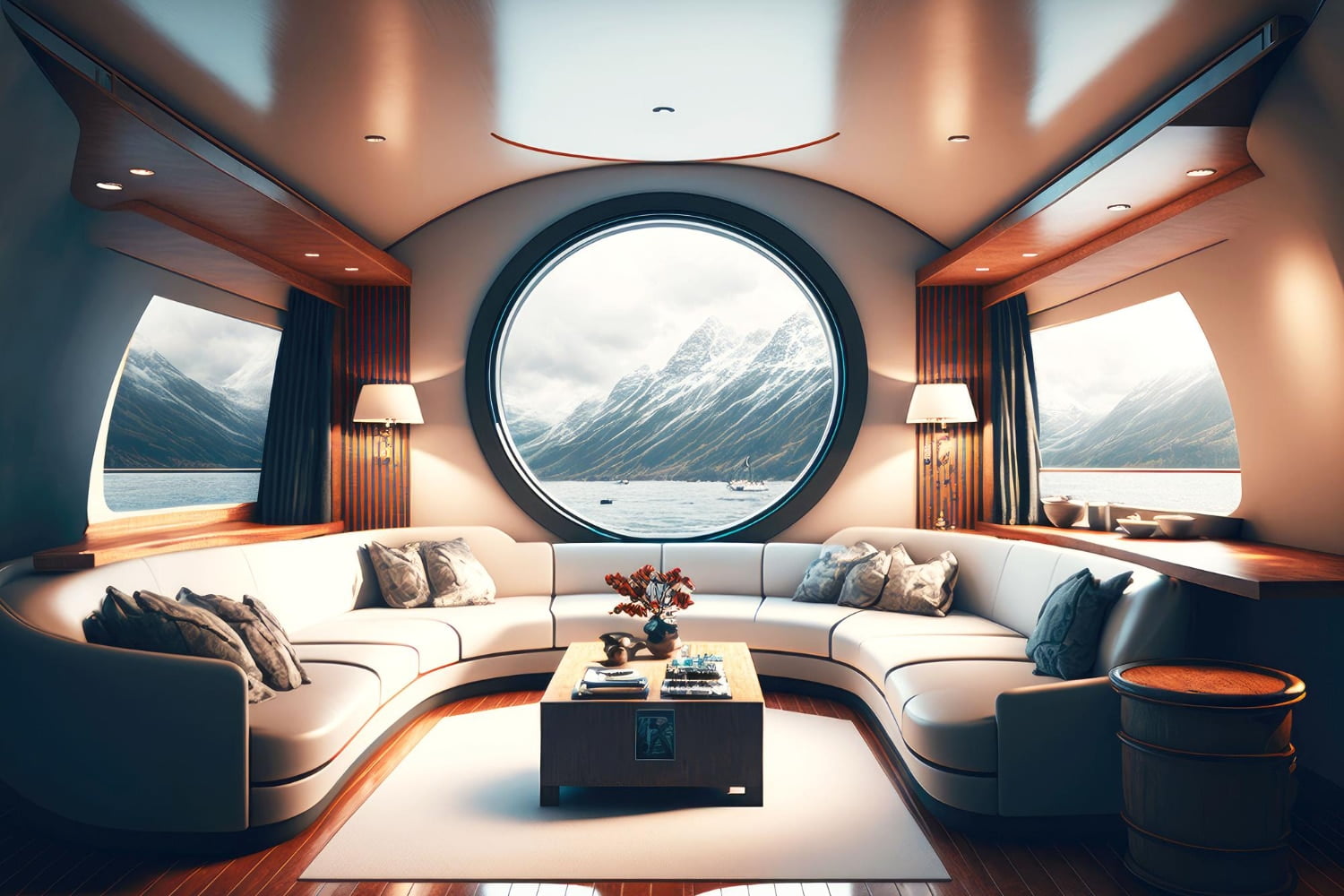
The saloon is where the design either comes together or doesn’t. It’s the main social space, the dining area, and often the workspace on passage. The furniture arrangement needs to account for all three states without requiring a full rearrangement to switch between them.
- Curved or angled settee runs that follow the hull line maximize seating without wasting the space behind the sofa back.
- A drop-leaf or sliding table gives full dining capacity when needed and open floor space when stowed; the best ones lock firmly in both positions.
- Under-settee storage with proper access (meaning a hatch that opens without moving cushions and unscrewing panels) makes the space genuinely functional rather than theoretically efficient.
The lighting system in the saloon benefits from a layered approach: overhead ambient panels for general use, lower accent lighting near the waterline for evening atmosphere, and at least one focused reading light at each seating position. This kind of zoning isn’t standard on most production boats, but it’s straightforward to implement during a refit and it substantially changes how the space feels after dark.
Customization and Personalization
Art and Decor Details

The selection pressure in boat decor is ruthless. Everything that goes on a boat has to survive the environment, stay secure when the vessel moves, and earn its footprint. I’ve come to think of this as “committed restraint”, fewer objects, chosen carefully, each one doing visual and practical work. A set of three small framed prints screwed through the backing to the bulkhead, flush against it rather than hung on wire, reads intentional and doesn’t become a projectile offshore. A single sculptural bowl secured with museum wax adds warmth without accumulating clutter. The impulse to decorate exactly as you would a house needs to be edited down, but the result of that editing, when done well, feels sharper and more deliberate than most residential rooms.
Technology Integration

Modern electronics integration in a boat interior is an opportunity to reduce visible complexity rather than add to it. Multifunction displays that consolidate navigation, engine monitoring, and environmental controls in one flush-mounted panel look cleaner and occupy less footprint than the legacy instrument clusters they replace. AV systems have followed the same trajectory: a built-in screen with a concealed soundbar below looks furniture rather than equipment. The one area I push back on is automation for its own sake, a lighting system that requires a tablet to operate becomes a real problem when the tablet is dead and someone needs to find the head at three in the morning. Physical backup controls for core systems are a design constraint worth respecting, not a limitation to work around.
Sustainable and Eco-Friendly Options
The sustainability conversation in marine design is partly about values and partly about practical performance. Recycled and low-impact materials have improved to the point where they’re not a compromise, in some cases they outperform conventional alternatives. The argument for integrating sustainable choices into boat interior work is both principled and pragmatic, and the material options to support it have genuinely caught up with the intent.
Solar Panels and Green Energy

Flexible solar panels have changed the calculus for electrical systems on cruising boats. Modern monocrystalline panels in flexible formats can be integrated into biminis, dodger surfaces, and coach roofs without the structural reinforcement requirements of rigid panels. A well-sized array covers hotel loads on most cruising boats in most latitudes without running the engine or a generator for daily use. For interior design purposes, this matters because it removes the noise and heat of generator operation from the habitability equation. LED lighting’s low draw is what makes solar viability possible, the two technologies reinforce each other. Looking at several retrofits where the shift to all-LED plus two flexible panels on the bimini completely changed what it felt like to live aboard.
Recycled and Sustainable Materials
In my view, boat and yacht owners should pay real attention to the environmental impact of the materials they use for furniture, flooring, and finish elements. The options have expanded meaningfully, and they’re not compromise choices:
- Recycled aluminum and stainless: Hardware and accent pieces made from recycled marine-grade metals perform identically to virgin material and carry a lower environmental cost across the production chain.
- Reclaimed teak: Salvaged teak from demolished structures or dismantled vessels has the same rot-resistance properties as new teak, and the patina often looks better: more character, less uniformity.
- Bamboo composite: Bamboo-based panels and flooring products offer structural performance comparable to hardwood at lower weight, with a much faster regeneration cycle than harvested timber. Worth specifying where the application fits.
Making these choices requires doing the sourcing work: not every product marketed as sustainable to the marine industry delivers on its claims. I cross-reference with third-party certification bodies and, where possible, with supply chain documentation from the manufacturer. The overhead is real. for a home who prioritize this dimension, the end result is a thoughtfully specified interior that what really matters its environmental commitments rather than just claiming them.
Boat Interior Design: A Fusion of Comfort and Style

What I keep returning to in boat interior design is that the constraints are clarifying. When you can’t default to the comfortable choices, you find the right ones. The decisions that make a boat interior actually work, the material selections, the layout logic, the storage integration, the lighting design, all produce quality outcomes because they’re based on understanding the environment rather than just applying aesthetics.
The style of a boat interior comes out of those functional decisions, not before them. A teak and cream saloon with warm LED downlighting and clean joinery looks elegant because the materials and proportions are right, not because someone applied an “elegant” palette on top of poor structural choices. The same logic applies to contemporary boat interiors with stone countertops and brushed aluminum hardware. The style coheres because the material logic is sound. I’ve seen enough projects fail the other way, great color palette, wrong foam, wrong wood, wrong lighting approach, to know which decision actually drives the outcome.
If you’re starting a new boat interior project or planning a refit, start with the hard questions: what materials will survive this environment, how will every zone function both underway and at anchor, and where does storage come from without compromising the spatial feel. Aesthetics follow from good answers to those questions. For anyone applying similar thinking to tight residential spaces, the space efficiency principles I’ve covered in smaller-footprint contexts translate directly.
Frequently Asked Questions
What are some tips for boat interior lighting?
LED is the baseline: lower power draw, longer lifespan, and no heat buildup in enclosed spaces. Think in zones: warm white (2700-3000K) for sleeping and social areas, neutral white for the galley, and dim red or blue for cockpit use at night to protect night vision. Physical dimmer switches at each zone, not just a central panel, give you real flexibility. Use the boat’s natural light wherever possible: well-placed hatches and ports let you run on daylight through most of the daytime hours without drawing on the battery.
How do you make the most of a small boat interior?
Start with the berths and the galley; those define the minimum functional footprint and everything else builds around what remains. Storage needs to be accessible without moving three other things to reach it: that means accessible hatches, pull-out drawers, and properly organized lockers rather than deep bins. Vertical surfaces are underused in most boat interiors: wall-mounted racks, magnetic strips in the galley, and shallow shelves above berths all add storage without consuming floor space. Light overheads, pale upholstery, and mirrors in narrow passageways make a compact cabin feel larger than it measures.
What are some current boat interior design trends?
The clearest shift I’m seeing is away from nautical cliche (navy, chrome, anchor motifs) toward interiors that feel closer to residential architecture. Warm neutrals, natural material textures, clean joinery without ornament, and lighting that responds to time of day. There’s also genuine interest in modular furniture systems that reconfigure for different uses, rather than fixed layouts that compromise on at least one function. Sustainability is becoming a real client priority rather than a box-ticking exercise, and the material options to support it have caught up with the demand.
If you found this guide on boat interior design useful, consider following us on Pinterest , we post regularly on interior design across all styles and contexts.