Modern Dark Bedroom Ideas for a Feel-Good Home

The first time Someone asked me to design a dark bedroom, I hesitated. She had a north-facing room in a the city townhouse with one small window. What I discovered over the next few weeks changed how I think about dark interiors entirely: the darkness itself was never the problem. Every dark bedroom that fails does so because the foundational decisions got skipped. Not the paint color. The decisions underneath it: texture, light layering, material contrast, and where you give the eye something to land.
This is a guide to those decisions, not just a collection of rooms that photograph well. If you want to understand the principles that make any interior work, dark rooms are one of the clearest test cases: there is nowhere to hide.
Why Dark Bedrooms Often Go Wrong
Most dark bedrooms I have been called in to fix share the same problem: the darkness was not designed, it just happened. A single deep wall color, flat overhead lighting, furniture that does not do anything visually distinct. The room ends up feeling heavy instead of dramatic.
The key principle here is that dark works through contrast and texture, not through volume. A room can be 80% dark materials and still feel balanced if those materials vary in finish and the lighting creates visual depth. A room with one dark wall and no thought about the rest will always feel unfinished.
The Accent Wall as a First Commitment
An accent wall is not a compromise. It is a legitimate design choice that many professional designers use as the primary move, not a fallback. The most effective dark accent walls I have seen are positioned behind the headboard, which creates visual weight exactly where a bedroom needs it: at the focal point when you enter the room.
If you are unsure about committing to paint, a peel-and-stick wallpaper in a dark pattern lets you test the visual effect without permanence. What you are really testing is whether the room has enough natural light to handle the contrast. If the accent wall makes everything else look dingy, you need more reflective surfaces, not a lighter wall color.
Dark Furniture Before You Touch a Wall
Before committing to wall color, I often suggest starting with the bed frame or a large piece of furniture in a dark finish. This does two things: it shows you how dark materials behave in that specific light environment, and it gives the room a natural focal point that is easy to reverse if you change your mind.
A dark upholstered platform bed in charcoal or deep navy looks architectural rather than just heavy. Paired with lighter bedding, the contrast becomes the design. I have seen this work in rooms with as little as one east-facing window. The key is keeping the rest of the room relatively neutral so the furniture does its job without competing with anything else.
All-In Dark: When Full-Room Color Actually Works
The assumption that a fully dark bedroom will feel oppressive comes from rooms where nothing else was considered. Designing three all-black bedrooms in the past five years. None of them felt depressing. All of them had one thing in common: layered lighting that treated the darkness as a backdrop, not the point. For how dark color choices function in other rooms beyond the bedroom, the same principles that govern dark interior design broadly all apply here.
The Case for All-Black (It Is Warmer Than You Think)
Most people get the scale of black wrong. They go halfway: black walls, gray bedding, dark floor, and then wonder why the room feels cold. A fully committed all-black room works because the consistency eliminates visual competition. Every object is legible against it. When I have specified deep matte black for all four walls in a master bedroom, the client reaction is almost always the same: “It is warmer than I expected.”
The material finish matters more than the color itself. Matte black absorbs light and makes the room feel enclosed; satin creates subtle movement when light hits it at an angle. For small rooms, matte is almost always the right call. For larger rooms, a satin finish prevents the walls from disappearing entirely and keeps the room from feeling sealed off from the rest of the space.
Black and White as the Structural Starting Point
Black and white is the most versatile starting point for a dark bedroom because it is optically stable. The high contrast creates visual interest without the room feeling thematically heavy. It is also the most flexible base: once the room is established in black and white, any accent color you add becomes a considered design choice rather than a color theory accident.
I have recommended this approach to clients who were not sure whether they wanted a permanent dark scheme. It works equally well as a long-term design or as a scaffold for something more specific later. The contrast ratio carries the look; you just have to not undermine it by adding too many competing tones at once.
White Bedding Against a Black Wall: The Structural Move
White bedding against a black wall is not the obvious choice. It is the structural one. The contrast ratio between matte black paint and white linen is high enough that the bed becomes the literal brightest element in the room, which is exactly where you want the eye to go first when you walk in.
Worth noting: the quality of the white matters. Bright white looks clinical against matte black. A warm off-white or natural ivory works far better. Belgian linen in an unbleached natural white, or a high-thread-count cotton in warm white, is almost always the right choice. The slight warmth in the white prevents the room from looking like a graphic exercise rather than a bedroom someone actually sleeps in.
Texture and Natural Materials in a Dark Space
What separates a dark bedroom that looks expensive from one that feels heavy is texture. When all surfaces share the same visual weight, flat paint against flat furniture against flat floor, the room looks dense rather than deep. Natural materials break that pattern and are usually what is missing from dark rooms that do not quite work.
Wood Detailing That Prevents a Room from Feeling Like a Basement
Dark wall color combined with wood detailing works in nearly every scale of room. The grain of the wood creates visual movement; the warmth of the tones counteracts the potential coldness of navy or charcoal. In practice, this means paneling on one wall, a wood ceiling detail, or furniture with visible grain rather than just a stained finish.
I have used white oak paneling with deep forest green walls in a 10-by-12 bedroom, and the result looked architectural rather than small. The panels draw the eye vertically, which adds visual height. If you can only do one thing to introduce texture into a dark bedroom, wood is the right choice. It is the material that most reliably makes darkness feel considered rather than accidental.
The Rustic Approach: Dark Without the Sleekness
Contrary to what you see in most dark bedroom content, dark does not require sleek. Some of the most successful dark rooms Looking at had a rough, tactile quality: exposed wood beams, linen bedding, weathered metal hardware. The darkness became a backdrop for materials rather than the main event.
The test I apply to a dark room with natural materials: can you identify the texture of every surface in a photograph? If yes, the room has enough material variety. If everything blurs into one dark mass, something needs to break the pattern. A jute rug, an unfinished wood shelf, a linen throw are all low-cost interventions that change how the room feels entirely. For a related approach that uses the same restraint, the Japandi bedroom strategy applies many of these principles in a slightly different aesthetic direction.
Related garage setups in the same functional family: storage, work zones, and finishes that keep the space usable rather than decorative.
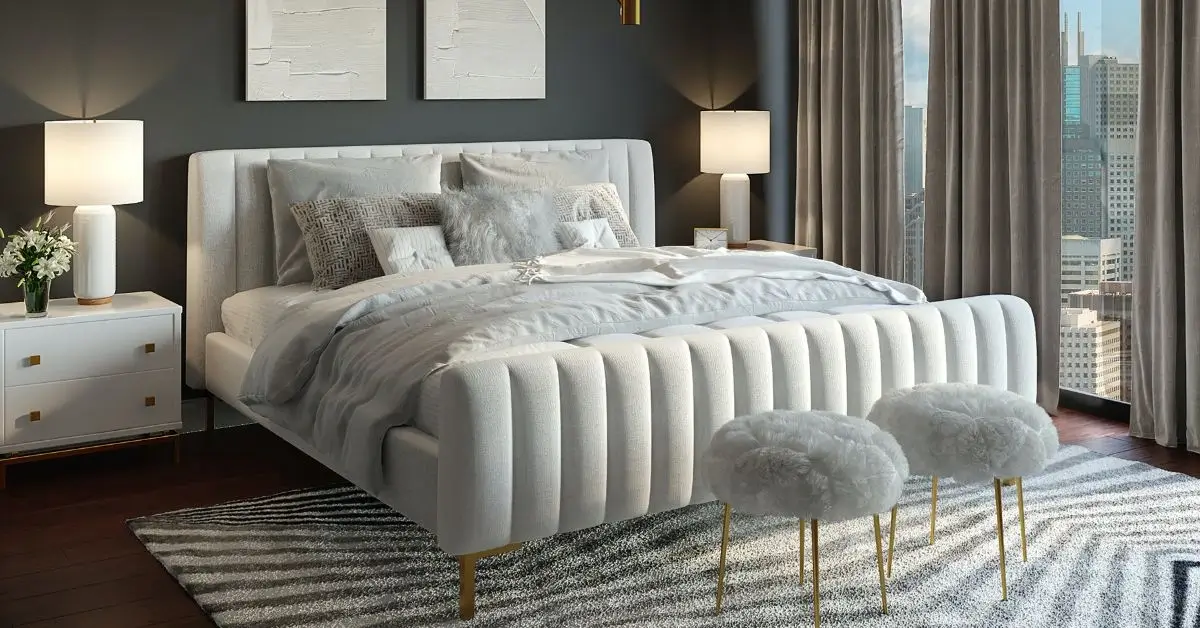
A modern dark bedroom treats darkness as a design tool rather than a color choice. The room above illustrates the principle: the dark walls create a recessive background that makes the furniture and bedding the active elements. The bed is the visual anchor; the walls are the space around it. That shift in thinking is what makes dark bedrooms work as rooms rather than just as photographs.
The Dark Color Palette Beyond Black
Black gets most of the attention in dark bedroom conversations, but the most livable dark rooms Designing consistently use a palette that stops short of absolute black. Navy, deep forest green, charcoal, and warm dark brown all behave differently and pair with different materials. Choosing between them is not purely aesthetic; it is a spatial and practical decision.
Navy Blue Walls and Why They Work in Low-Light Rooms
Navy blue is the most forgiving entry point in the dark palette. It has enough warmth to avoid the coldness that comes with cool gray or black, and it pairs naturally with brass, wood, white, and warm neutrals. In rooms with limited natural light, I consistently recommend it over black for a home who want drama without sacrificing livability.
The practical advantage is that navy registers as a color rather than as an absence of light. A room painted in deep, saturated navy with warm-toned wood and brass hardware looks rich. The same room in flat black can look simply dark. If you are not sure which end of the dark spectrum to choose, navy is the safer starting point and almost impossible to get wrong.
Charcoal Gray Feels Warmer Than You Expect
Charcoal gray surprises people. On a paint chip, the response is often “too cold” or “too industrial.” In a full room with warm materials, it behaves completely differently, particularly when paired with wood tones, cream bedding, or any warm metal. The undertone is what drives this: a charcoal with green undertones, such as Benjamin Moore’s Kendall Charcoal or Farrow and Ball’s Mole’s Breath, feels earthier and warmer than a blue-undertone charcoal of the same value.
I have specified both in client projects and the difference in how people respond to the finished room is significant. Always test with a large sample, at least twelve inches square. The small chip looks industrial; the large sample looks considered. That gap is bigger with charcoal than with almost any other color.
Gray Bedding and Getting the Tonal Values Right
Gray bedding against charcoal walls is a tonal approach that requires getting the value relationships right. The bedding should be two to three shades lighter than the walls: light enough to register as a distinct element, but not so light that the contrast becomes the dominant note. Medium-tone gray linen against deep charcoal creates exactly the kind of quiet visual interest that works in a room intended for sleep.
If the bed disappears into the wall, the bedding is too close in value. If the bed stands out too sharply, the bedding is too light. The goal is for the bed to be clearly legible while still existing comfortably within the room’s overall palette. Finding that balance is one of the more satisfying things to get right in a dark bedroom.
The Details That Make or Break a Dark Bedroom
A few related Pinterest references in the same visual family as the section above.
The real work in a dark bedroom is in the details: what you put on the walls, what you put on the floor, how you frame the bed. These choices accumulate into the difference between a dark room that looks designed and one that just looks dark.
Mirrors in a Dark Space (Used Correctly)
Mirrors in dark bedrooms are not about compensating for darkness. They are about creating depth. A large mirror introduces a second visual plane: when it reflects the room, it multiplies the texture and material variation rather than just bouncing light around.
Dark-framed mirrors work better than light-framed ones in this context because they stay within the room’s palette rather than interrupting it. A warm brass or gold frame is the exception: it introduces a point of light without breaking tonal consistency, which is a different and equally effective approach. Position the mirror so it reflects something interesting, not just the opposite wall.
The Headboard Choice That Anchors Everything
The headboard does more structural work in a dark bedroom than in any other context. Because the walls are recessive, the headboard becomes the visual landing point: where the eye settles when you enter the room. If the headboard is weak or visually flat, the room has no anchor.
Upholstered headboards in deep velvet or bouclé work best in dark rooms. They add texture at eye level, provide acoustic mass (dark rooms can feel echoey without enough soft surfaces), and make the bed look intentional rather than assembled. If I were advising someone on where to put their budget in a dark bedroom, the headboard comes first. A floor-to-ceiling upholstered piece in a deep jewel tone, charcoal, or near-black bouclé is almost impossible to get wrong in this context.
Rugs That Earn Their Place on a Dark Floor
A dark rug in a dark room is not redundant. The distinction is pile depth and texture. A flat-weave dark rug disappears into the floor; a deep shag or high-pile rug creates a tactile presence that registers even in low light. The goal is layering, not matching.
The alternative, a light rug against dark walls, works only if the contrast is intentional and the rug is large. A small pale rug against dark walls looks like an afterthought. If you go light, go substantial: the rug needs enough surface area to feel like a deliberate choice rather than a practical one.
Lighting Rules for Dark Bedrooms
Overhead lighting fails in dark bedrooms almost without exception. A single ceiling fixture creates a bright center and rapidly darkening edges, which is the opposite of what you want. The goal is multiple lower sources that create consistent warm pools of light throughout the room. If you want to make a dark bedroom genuinely comfortable to be in, lighting is where most of that work happens.
Multiple Sources Instead of One Overhead
The approach that works consistently in dark bedrooms is source lighting: you see the light source itself, a lamp, a sconce, a candle, rather than just an illuminated ceiling. This shifts the room from lit to lit from within, which is the quality that makes dark rooms feel intentional rather than just unlit.
In practice: two bedside sconces or lamps, plus a floor lamp in one corner, plus a table lamp if the room is large enough. Dimmers on everything. Keep the overhead fixture for functional use only, getting dressed, reading at full light, and never use it as the primary source when you are simply in the room. The difference this makes to how a dark bedroom feels is not a subtle one.
When Drama Is the Entire Point
For rooms where the goal is genuine drama rather than quiet livability, there is a version of dark bedroom design that pushes toward the theatrical. Deep burgundy, forest green, and dusty plum all carry emotional weight that neutrals do not. The rooms that succeed with these colors treat them as the architecture: every other element is quieter so the color can do its work. Minimal furniture, plain bedding, simple hardware. The color is the room.
The risk with high-drama colors is that they are unforgiving of clutter. A burgundy room that is slightly untidy looks chaotic rather than dramatic. If this is the direction you want to go, build in enough storage to keep surfaces clear. The drama requires the discipline to maintain it.
Frequently Asked Questions
How can I make my dark bedroom look nice?
Focus on contrast and texture rather than adding lighter colors. Vary the materials: matte walls with a textured rug, smooth bedding against a rough headboard. Add multiple warm light sources at lower heights instead of relying on overhead lighting, and give the room a clear focal point, usually the bed or headboard.
Is a dark bedroom OK?
Yes, if it is designed intentionally. Dark rooms reduce the ambient light that disrupts sleep, which many people find genuinely helpful. The key is having layered lighting for when the room needs to be functional and the ability to reduce all light when it does not.
What color scheme is best for a dark bedroom?
It depends on the room’s natural light and what you are pairing with the walls. For rooms with limited natural light, navy or deep forest green feel warmer than black or cool charcoal. For rooms with good natural light, deep charcoal and even black become viable options. Always test with a large sample, not a small paint chip.
How do you make a dark bedroom?
Start with the walls and commit to a finish: matte for an enclosed feeling, satin for more movement. Then layer the lighting with bedside lamps or sconces as the primary sources. Choose bedding and a rug that add texture and tonal contrast to the wall color. Add one large mirror for depth, positioned to reflect something interesting in the room.
What do you do if your room is too dark?
If the darkness feels oppressive, the problem is usually lighting, not color. Add a warm-toned floor lamp in the darkest corner, introduce one reflective surface such as a large mirror or metallic hardware, and check whether the bedding provides enough contrast to the walls. These three changes are often enough to shift how the room feels.
How do I stop my dark bedroom from feeling depressing?
The difference between dramatic and depressing is material variety and visible light sources. A room with one dark paint color, no texture variation, and a single overhead light will always feel wrong. Introduce something with grain such as wood detailing, something with pile such as a rug or throw blanket, and at least two independent light sources you can control separately.