Arabian Interior Design: Pattern, Geometry, and Shade

Arabian interior design is one of the most misread styles in the Western market. I say that as someone who has worked through three client projects that started with \”I want something Arabian or Moroccan\” and ended up requiring a serious education in what that actually means. The confusion is understandable, because Arabian design gets treated as an aesthetic category when it is really a formal system: a set of principles around symmetry, pattern logic, and material hierarchy that developed over twelve centuries of Islamic architecture and craftsmanship.
What separates a well-executed Arabian interior from a themed hotel lobby is the understanding that the ornament is structural. It is not decorating a surface, it is the surface. That is the key principle here, and it is what I will walk through in this guide: how each element works, why it works, and how to apply it without losing the coherence that makes the style genuinely compelling.
The Visual Language Arabian Design Built Its Identity On
Arabesque Motifs: Why They Work the Way They Do
The arabesque is a repeating geometric-floral pattern built on interlocking curves, and its organizing principle is infinite extension. A single arabesque motif tiles perfectly: each unit connects to the next without visible seams. That is not coincidence, it is a deliberate design choice rooted in Islamic philosophical concepts of divine order and continuity. For my IIT thesis project, I spent three weeks analyzing Alhambra palace tile patterns, and the mathematical precision involved changed how I think about symmetry in any interior.
In practice, this matters because arabesque works best at scale or in contained zones, not scattered randomly. A backsplash, a ceiling inset, a feature wall: these are contexts where the pattern can do what it was designed to do. One arabesque throw pillow on a generic sofa does not constitute Arabian design, no matter how many home decor accounts suggest otherwise.

by Imperceramica
Geometric Patterns as Structural Architecture
Geometric patterns in Arabian interiors are not the same as arabesques. Where arabesques are curvilinear and organic, geometric Islamic patterns are built on strict mathematical frameworks: eight-pointed stars, hexagonal grids, the intricate 16-fold rosette patterns found in Mamluk-era architecture. These patterns appear on floors, on carved wooden screens called mashrabiyya, and on tile work, and they create visual hierarchy through their placement in the room.
Most Western interpretations get this wrong. They treat geometric and arabesque as interchangeable, creating pattern-dense interiors that look chaotic rather than structured. The historical reality is that different pattern types occupied specific positions in a room: geometric on floors and lower walls, arabesque on upper registers and ceilings, calligraphy at eye level and above doorways. When you respect that logic, the room looks coherent. When you ignore it, it looks like a gift shop display.

Color and Light: The Sensory Core of the Style
Building a Warm Color Palette That Does Not Overwhelm
The classic Arabian palette runs deep: saffron, terracotta, indigo, burgundy, and gold, built on a base of warm whites and sand tones. But the organizing rule is saturation management. These are high-saturation colors used in focused applications, not wall-to-wall. A deep red accent wall, a cobalt tile floor, gold-touched ceiling details: each color occupies its zone. Spreading them evenly across every surface creates visual fatigue and loses the sense of intentional luxury that makes the style work.
A practical approach I use with clients: treat the palette like a spice rack. Saffron and burgundy are your primary notes (the accent walls, the upholstery), indigo and cobalt are sharp accents used sparingly (a single tile color, cushion trim), and gold is the finishing layer (hardware, light fixtures, frame details). This maps to how the style actually functions in traditional spaces, and it prevents the common mistake of adding too many competing saturations at once.
Lighting in Arabian Interiors: The Fanous Principle
The fanous, the perforated metal or glass lantern, is probably the most recognizable lighting element in Arabian interiors, and also the most copied poorly. The reason it works is the projection. A lit fanous casts a ring of geometric shadow patterns onto surrounding surfaces, making the light source part of the room\’s pattern system. That is elegant design. One fanous at the right height does more for an Arabian-inspired room than a dozen recessed downlights.

For a client project in Lincoln Park, I brought in a set of Moroccan brass lanterns from Badia Design in Los Angeles. At roughly $180 each, they sit in the mid-range, but the shadow patterns they projected on the ceiling justified every dollar. The budget alternative, frosted-glass lantern shapes with no perforation, does not project and misses the point entirely. The projection is the feature, not the lamp itself.
Materials and Surface Detail
Textiles: Silk, Velvet, and the Layering Logic
Arabian textile culture is deeply practical. Rugs were not purely decorative: in spaces with stone floors and temperature extremes, layered textiles regulated warmth and defined seating zones in rooms that did not have fixed furniture arrangements. That logic informs how to use them now.

by mostafa meraji
The textile hierarchy goes: base layer (a flat-woven kilim or dhurrie as foundation), middle layer (a thicker pile rug with geometric patterns as the primary textile element), and accent layer (cushions and throws in silk or velvet). I have seen this system work in contemporary apartments where the rest of the furnishings are completely clean-lined. The rug does the work, and nothing else has to carry the style. If I were recommending one investment for an Arabian-influenced room, it would be a genuine hand-knotted Turkish or Persian rug from a reputable dealer, not a machine-made printed version. The difference in color depth, pattern scale, and longevity is significant enough to matter visually from the first day.
Wood and Metalwork: Craft as Decoration
Arabian woodwork operates on a different premise than most Western furniture traditions. The decorative carving, the inlay work, the geometric fretwork of mashrabiyya screens: the ornament is not applied to the structure, it is the structure. A carved wooden door panel is not a plain door with carvings added. The carving is what defines the form itself. That distinction matters when you are sourcing pieces for a room.

In residential application, the commitment is about where you place craft-intensive pieces, not how many you have. One genuinely good carved wood console or mashrabiyya screen does more than an entire room of mass-produced pieces with geometric decal prints. Brass and copper metalwork follows the same logic: hammered or engraved surfaces, not polished flat ones. The texture is part of the visual language, and smooth machine-finished metal looks like entirely different material in this context.
Calligraphy and Mosaic: The Two Elements That Anchor the Style
Arabic Calligraphy on Walls: How to Use It Without Cliche
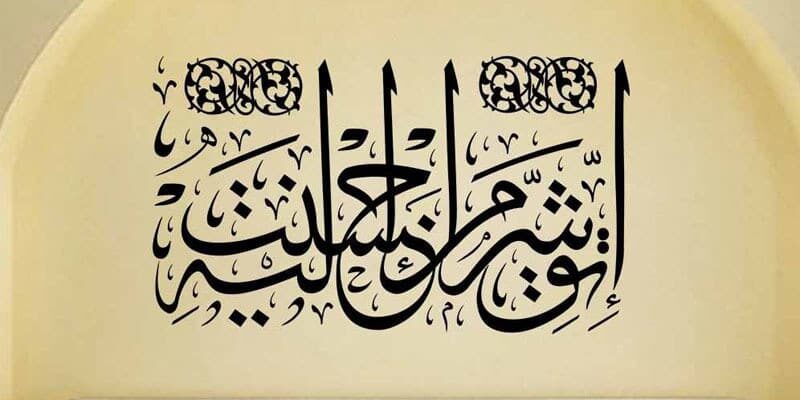
Arabic calligraphy is one of the highest art forms in Islamic culture, and using it as wall decoration in a non-Arabic household carries real interpretive responsibility. The most defensible approach: use calligraphy in contexts where its meaning connects to the space, or commission work from a practicing calligrapher who can explain the selection. At minimum, know what the text says before you hang it.

by Muhammad Hussam
What I would avoid: purchasing a generic \”Arabic writing\” print from a home goods store where neither buyer nor seller knows the content. This is both aesthetically risky and culturally careless. If you want the visual register of calligraphy without the interpretive obligation, geometric or arabesque work provides the same formal weight. The patterns are a design language that stands independently.
Mosaic Tile and Its Structural Role in the Room
Zellige, the traditional Moroccan hand-cut mosaic tile, and its Arabian equivalents share the same design logic: each individual piece is part of a larger mathematical structure. The colors work because they were designed for adjacent placement, and the hand-cutting produces a slight surface irregularity that catches light differently from machine-cut tile. That surface variation is not a flaw, it is the point.

The layering of tile, textile, and furniture in an Arabic interior is a specific application of balancing principles. For a deeper look at how these principles work across any design style, the guide to harmony in interior design covers the compositional logic that governs how competing visual elements coexist without canceling each other out.
Architectural Elements Worth Understanding Before You Renovate
Arches and Vaulted Ceilings: When They Work and When They Do Not
The horseshoe arch and the pointed arch are structural signatures of Arabian and Islamic architecture, and they work in interiors because they frame and direct attention in a way rectangular openings do not. A doorway with a keyhole arch creates a visual event. A vaulted ceiling with geometric painted details becomes the room\’s primary design feature rather than a neutral overhead surface.

The problem is that arches in residential remodels are usually executed poorly: too shallow a curve, wrong proportions, rendered in smooth modern drywall instead of plaster with depth and texture. If you are adding architectural elements like arches to a renovation, the proportions matter more than the mere presence of an arch. A well-proportioned arch in the right context (a doorway to a primary room, a decorative niche) is worth the investment. Random arches applied without understanding their geometric logic add visual noise. Before committing to structural changes, it helps to understand how emphasis functions in a room overall. The primer on emphasis in interior design covers this in a way that applies directly to the decision.
Applying Arabian Design Room by Room
The Living Room as Majlis: Getting the Layout Right
The traditional Arabian living room is a majlis, a gathering room organized around hospitality. Its organizing logic: many seating positions of equal status arranged around the perimeter, floor-level or low seating options available, and a center of gravity created by a central rug or low table arrangement rather than a television wall. That logic is worth carrying into a modern interpretation even if you cannot commit to the full format.

A client in suburban Chicago wanted an Arabic influenced living room but could not give up her existing sofa layout. The approach that worked: keep the sofa configuration, add oversized floor cushions in front of it as a secondary seating zone, use a quality Turkish rug to unify the space, and replace the recessed ceiling lights with a pair of brass fanous pendants. The ceiling detail and the lighting did most of the work. The room looked considered rather than themed. For a closely related regional style that shares significant visual vocabulary through the shared Moorish heritage, the Moroccan interior design guide covers the distinctions worth understanding. The key difference is that Moroccan design tends toward more restrained color application in contemporary settings, while Arabian design, particularly the Gulf and Levantine traditions, runs richer in warm gold and jewel tones.
The Bedroom: Layering for Depth, Not Clutter
The bedroom in an Arabian-influenced interior should feel enclosed and rich. The design logic: a high-profile bed frame with carved or metal-inlaid details, multiple layers of bedding in contrasting textures (a velvet duvet over linen, embroidered pillowcases over plain), heavy curtains that create visual weight on the walls, and a ceiling or bedside lantern as the primary light source rather than overhead fixtures.
The key restraint: you do not need every element to make it work. I have seen Arabian-influenced bedrooms that functioned with just three things: a carved wooden headboard, an authentic Persian runner beside the bed, and a pair of brass bedside lanterns. Three elements, properly chosen and proportioned, and the room looks intentional. The coherence comes from consistency of vocabulary, not volume of pieces. This is the same principle that governs any design style done well, as covered in the interior design basics guide.
Working Arabian Elements Into a Modern Interior Without a Full Stylistic Commitment
If you are working with a contemporary base and want to introduce Arabian-influenced elements without overhauling the entire interior, the entry points that work are lighting, textiles, and one architectural accent. A set of perforated brass pendants over a dining table does more design work than a collection of accessories. A hand-knotted rug with geometric pattern grounds a room and provides a cultural reference point that looks considered rather than costumed. One carved wood or mashrabiyya screen as a room divider or feature element adds craft without demanding a full stylistic commitment from the rest of the space.
What I would avoid: the \”Arabian corner\” approach, where you cluster all the thematic elements into one zone of a room. That creates a vignette, not an integrated design. The Arabian and Persian design traditions share visual motifs but differ in layering density and color saturation. Understanding both helps when you are making selective borrowing decisions. The guide to Persian interior design covers those distinctions in useful detail.
Frequently Asked Questions
If you liked this post about arabian interior design, don\’t forget to follow us on Pinterest so you don\’t miss any more interior design news!