Dark Bedroom Aesthetic: A Guide to the Visual Sub-Styles

The phrase “dark bedroom aesthetic” gets searched millions of times, but people using it aren’t always looking for the same thing. Some want dark academia: warm amber light, aged wood, books stacked on every surface. Others are after gothic romanticism: velvet draping, canopy frames, jewel tones so saturated they feel like colors from another century. A third group is drawn to something I’d call cinematic dark: spare, high-contrast, the visual language of film noir translated into a sleeping space.
What they share isn’t a specific color or material. It’s a commitment to a particular visual mood: enclosed, intentional, and atmospheric in a way that a bright room fundamentally cannot be. After working with clients who come in with dark bedroom Pinterest boards and asking them to describe what specifically they’re responding to, I’ve developed a clearer picture of how this aesthetic actually breaks down. Here’s how I’d map it.
The Visual Sub-Aesthetics
The Difference Between Dark Walls and a Dark Bedroom Aesthetic
This is the framing that shapes everything else: having dark walls and having a dark bedroom aesthetic are not the same thing. A room with a charcoal accent wall and otherwise neutral furniture has dark walls. A room where every element has been chosen to reinforce a specific visual mood has the aesthetic.
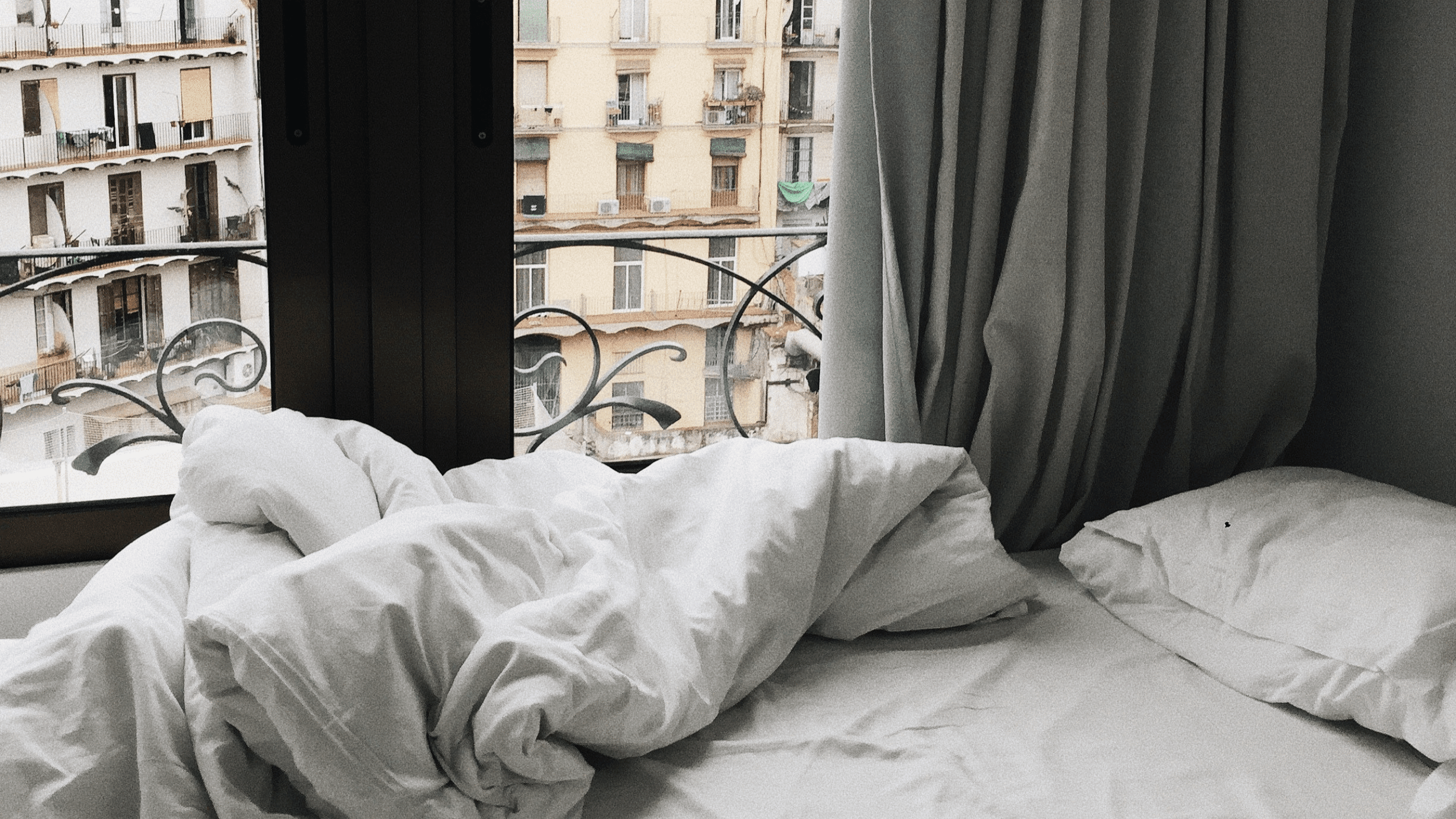
The key indicator is whether the darkness is doing compositional work. In the room above, the dark surface isn’t just behind the bed. It’s framing a scene. The headboard, the bedding, and the light source all participate in the same composition. Each element has been selected with the dark background in mind rather than independently. That’s the distinction the aesthetic requires. It changes how you make decisions in the room, from the beginning, not after the walls are painted.
Dark Academia: Warmth, Aged Wood, and Visual Density
Dark academia as a bedroom aesthetic has a specific palette that separates it from other dark interior styles. Where gothic goes to jewel tones and pure black, dark academia works in browns, deep forest greens, warm burgundy, and a black that reads as closer to espresso than ink. Wood is central, and it tends toward aged or raw rather than sleek and lacquered.
The visual density is what makes dark academia rooms read as a distinct aesthetic. Books, layered textiles, collected objects on surfaces: the composition is full without feeling crowded. Light sources are characteristically warm and localized, a brass reading lamp, a single pendant at low wattage. The effect is less bedroom and more private library. I find this the most personally interesting of the dark bedroom sub-aesthetics, because there’s always something else to notice when you look closer. The details reward attention in a way that a more minimal dark room doesn’t.
Gothic and Romantic: Velvet, Drama, and Intentional Excess
The gothic bedroom aesthetic commits to a visual vocabulary that the other dark sub-aesthetics pull back from: draped fabrics, canopy frames, jewel tones saturated to the point of aggression. Deep emerald, sapphire, plum. Velvet on every soft surface. A general sense that more is more, as long as everything sits within the same tonal register.
The black and white composition here is interesting because it shows the structural logic of the aesthetic without the color saturation. The formal contrast, the weight of the composition, the visual density: these are the gothic bedroom impulses stripped to their essentials. What remains is the underlying commitment to drama and intentional excess, just translated into a more restrained palette. The material choices (velvet, draping, layered pillows) carry the mood that jewel tones would carry in a more saturated version of the same room.
Moody and Cinematic: High Contrast, Spare Surfaces, Film Noir
The cinematic dark bedroom is the hardest of the sub-aesthetics to define, because it’s primarily about light rather than materials. Film noir is the useful reference point: spare rooms, a cool-to-neutral palette, and visual interest that comes from where the light falls rather than from what objects are in the room. The shadow is as important as the illuminated surface.
In practice, this translates to fewer objects, higher contrast between the light source and the surrounding darkness, and furniture chosen for silhouette rather than surface detail. When this aesthetic works, the room looks like someone made exactly five careful decisions and stopped. It’s the most demanding version of the dark bedroom aesthetic, because it has nowhere to hide imprecision. Every element has to be right, because there aren’t enough of them to redirect attention from a wrong one.
The Visual Elements That Build the Aesthetic
Contrast Is What You’re Actually Responding To
When I look at which dark bedroom images get the most saves, the common quality isn’t the darkness itself. It’s a specific contrast moment: dark floor against pale bedding, black wall behind a cream lamp, the shadow line at the edge of a lit surface. The darkness is the condition. The contrast is the experience.
Dark wood floors at this scale do something at the ground plane that no other element can do as efficiently. The visual distance between a near-black floor and mid-toned bedding gives the room a settled, compositionally intentional quality. The floor isn’t decorative in this context. It’s structural: it anchors the hierarchy of the space and gives the contrast a foundation to build from. For the underlying visual principles that apply across all dark interior styles, this guide on dark interior design covers the logic in more depth.
Texture Is the Primary Visual Content in a Dark Room
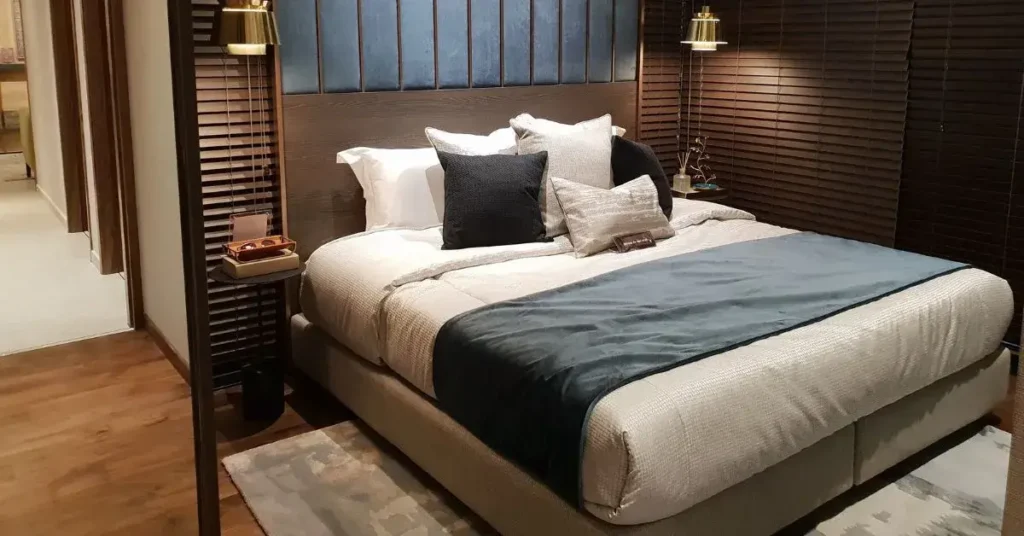
In a light room, texture is a quality you might appreciate on close inspection. In a dark room with a narrow tonal range, texture becomes the primary thing the eye reads. Smooth velvet against coarse linen, polished stone against brushed brass, matte wall against a glazed ceramic: these variations are what give the room visual substance rather than just visual darkness.
The dark bedroom aesthetic images that look flat almost always share the same quality: every surface at the same texture. A matte painted wall, matte bedding, matte furniture, all reading at the same visual frequency. The palette is right but the surface interest isn’t there. I’ve noticed this in rooms where clients commit to the color correctly but don’t think carefully about material selection. The tonal range alone doesn’t create the aesthetic. The material variation within that tonal range is what makes it work as a visual composition.
Layering Creates Visual Depth That Photography Flattens
One of the qualities that makes dark bedrooms photograph less well than they look in person is that they depend on visual depth: the sense that there’s something to see behind the obvious surface layer of the composition. A throw across the foot of the bed, a stack of pillows at different textures, a nightstand object that catches light differently than everything surrounding it. None of these elements individually carries the aesthetic. Together they create the visual complexity that distinguishes a dark bedroom that looks designed from one that just looks dark.
I tell clients building their first dark bedroom to think of layering as adding visual distance to the composition. Each layer gives the eye somewhere further back to travel. The room that feels rich and atmospheric in person is almost always a room with four or five distinct visual layers, even if you can’t immediately identify all of them. If you’re also working on the warmth and livability of a dark bedroom alongside the visual depth, this piece on making a dark bedroom actually comfortable covers that dimension.
Metallics, Art, and the Composition’s Final Layer
Metallics as Light Points in a Dark Field
The visual function of a metallic accent in a dark room is straightforward when you think of the room as a composition: a brass lamp or a gold-framed mirror is a light point in a dark field. The eye goes there first. It anchors the visual hierarchy. Without those points, a fully dark interior has no visual structure, just a uniform surface of similar tone and value.
What determines whether metallics do this work effectively is temperature alignment with the overall palette. Warm brass in a warm-dark room reinforces the tonal register of the space and the eye reads them as belonging. Cool metallics (chrome, nickel, steel) in a warm-dark room create a mismatch that most people notice without being able to name it. The metallic accents are present and technically correct in isolation, but they’re pulling the eye in a different tonal direction than the room. It’s the kind of decision that looks minor at the planning stage and reveals its importance once the room is finished and lit.
Art and Velvet: How the Final Layer Completes the Room
The same compositional logic that applies to metallics applies to art: in a dark bedroom, the pieces that work function as visual events rather than decorative additions. A small print on a dark wall disappears into the surface. A large-format piece with strong internal contrast, or a significant metallic frame, becomes a focal point with actual visual authority. Gallery walls, which work well in bright rooms because each piece remains individually legible, tend to blur into textural noise against dark surfaces.
What the velvet in this composition is doing is comparable to art in the same sense. The pile of velvet across a surface isn’t just material richness. It’s visual behavior in low light that flat fabrics don’t have. The surface shifts slightly as you change viewing angle. It catches and releases light differently at different distances. That’s why velvet consistently works in dark bedrooms where other upholstery choices fall flat. It’s not about luxury signaling. It’s a material that actively participates in the visual environment of the room. For anyone interested in how this extends into more dramatic dark territory, the piece on modern Gothic interior design covers that part of the aesthetic spectrum.
How to Identify Which Sub-Aesthetic You’re Actually After
The Diagnostic Question: What Specifically Is Attracting You to the Image?
Most people come to the dark bedroom aesthetic through images, and most of those images are doing several things at once. A dark academia room has the aged wood, the warm lamplight, and the dense objects all operating together. The problem with saving images without interrogating them is that you may end up committed to an aesthetic that requires all three of those elements, when what you’re actually responding to is just one of them. Getting clear on this early saves a significant amount of rework later.
In my experience, the most reliable diagnostic question is: if I stripped this image down to just one element, which element would I need to keep for the room to still feel like itself? If the answer is the warm amber light, you’re probably drawn to dark academia and the other elements are secondary. If the answer is the velvet and the draped fabric, you’re in gothic territory regardless of the wall color. If the answer is the contrast ratio between the lit surface and the surrounding shadow, you’re after the cinematic version, and density of objects will actually work against you. Being able to answer this question honestly is worth more than any mood board.
Translating Visual Inspiration into Specific Room Decisions
Once you’ve identified which sub-aesthetic you’re working toward, the practical decisions become significantly clearer. Dark academia rooms need a light source plan before almost anything else: the warmth of the space depends on localized, low-wattage sources rather than ambient overhead light. Gothic rooms require a commitment to material weight from the bed outward: the canopy or draped fabric has to come first or the jewel tones will float unanchored. Cinematic rooms need the negative space protected before you add anything at all: the temptation to fill surfaces has to be resisted or the high-contrast visual logic collapses into ordinary clutter.
The most common mistake I see is trying to merge sub-aesthetics at the furniture selection stage. Someone wants the book density of dark academia and the jewel tones of gothic in the same room. This can work, but it requires a clear tonal anchor, usually a single dominant wall color that both sets of elements respond to. Without that anchor, the room has two visual systems competing rather than one unified composition. If you’re at the stage of making the practical decisions that translate this aesthetic into a specific bedroom, the breakdown of dark bedroom ideas that actually work in different room configurations is a useful companion to the visual analysis here.
Frequently Asked Questions
What exactly is the dark bedroom aesthetic?
It’s a design approach where every element in the bedroom (walls, furniture, textiles, art, lighting) has been selected to reinforce a specific atmospheric mood rather than just having dark-colored walls. The aesthetic is defined by intentionality and visual coherence, not by any single color or material.
What are the main sub-aesthetics within the dark bedroom category?
The three most distinct are dark academia (warm tones, aged wood, books, localized warm light), gothic and romantic (velvet, jewel tones, draped fabrics, intentional excess), and cinematic or moody dark (spare, high-contrast, cool palette, film noir visual logic). Each draws on the same commitment to atmosphere but through a different visual vocabulary.
How is the dark bedroom aesthetic different from just having dark walls?
A dark room has dark walls. A dark bedroom aesthetic is a room where the darkness is doing compositional work: framing the bed, providing contrast for specific elements, giving the eye a structured path through the space. Every element has been chosen in relation to the dark background, not independently of it.
What makes a dark bedroom aesthetic look rich rather than gloomy?
Texture variation and contrast points. A dark room with uniform surfaces at the same texture reads as flat. A dark room with velvet against linen, polished brass against matte walls, and a large-format artwork with strong internal contrast reads as atmospheric. The richness comes from material variation within a narrow tonal range, not from adding more objects.
Is the dark bedroom aesthetic difficult to live with day to day?
Less than most people expect. The rooms that feel oppressive are usually the ones that went halfway: dark on one wall and pale on three, or dark walls with no contrast moments and no texture variation. A committed dark bedroom with deliberate layering and at least a few points of light (metallics, white bedding, warm lamps) settles into something that feels atmospheric rather than heavy.